

Portable Underwater Generator® (PUG) Helping Team Creating ‘Smart Reefs’ to Combat Coastal Erosion in South Carolina
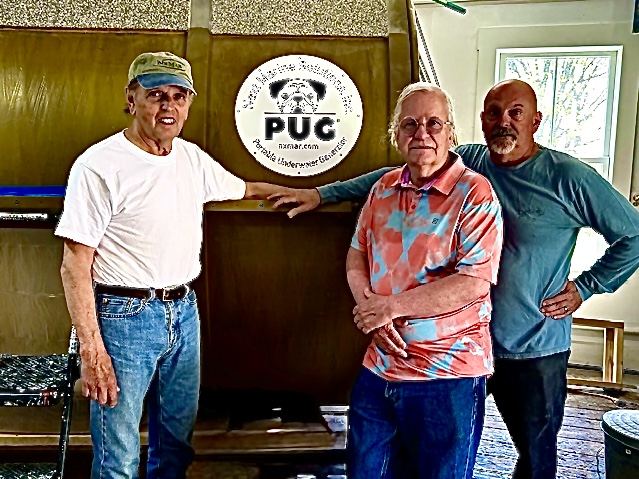
Pictured are members of PUG® crew (l-r) are Bill Peterson, PUG®’s inventor and NxMAR, president; Chuck Benton (electronics); and Larry McQuay (mechanical).
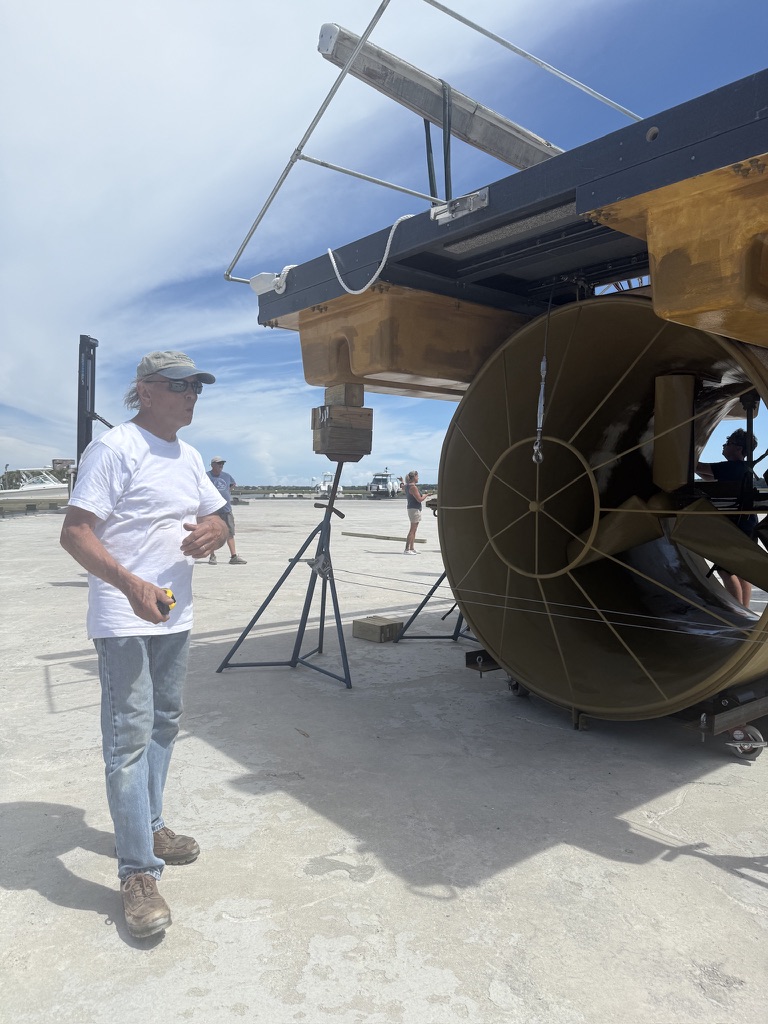
Bill Peterson stands before PUG® about to go into water.
Next Marine Solutions, Inc., partners with Coastal Carolina University (CCU) on innovative project using electricity generated by ocean currents
PORT ROYAL, SC, UNITED STATES, April 15, 2026 /EINPresswire.com/ -- It was a unique challenge: how to supply electricity to teams building “smart reefs” along the coast intended to mitigate erosion that destroys a significant amount of the scenic South Carolina shoreline every year.
The solution? Deploy a NxMAR® Portable Underwater Generator (PUG®) near the reefs to convert ocean currents into electricity needed to manufacture the “biorock” used to help build the reefs and to power the sensors and data collection instruments they host. Using innovative technology developed and patented by Maine-based Next Marine Solutions, Inc., PUG®s can reliably generate electricity regardless of whether the sun is shining or winds are blowing.
“In association with a team led by Coastal Carolina University (CCU), NxMAR® has begun a long-term demonstration to manufacture ‘biorock’ combining electricity, metal and salt water to accelerate development of ‘smart’ barrier reefs,” said William Peterson, a retired Navy captain and naval architect who developed the PUG® technology and heads a multi-discipline team at NxMAR®. The smart reefs, positioned along a section of South Carolina shoreline near Parris Island, are constructed of more than 200 concrete highway barriers with a cement-like material (biorock) filling in the spaces between them. (Biorock is formed when a small electric current is passed between underwater metal electrodes placed in seawater.)
“This program will be funded and expanded over multiple years to include collection, fusing and distribution of scientific data essential for achieving solutions to the many challenges faced by our coastlines, waterways and surrounding communities,” Peterson said, pointing out that more than 40% percent of the world’s population lives within 60 miles of shorelines.
“One of the many things that are unique about NxMAR® is we're not just selling electricity. We're taking it a step further and applying it to important projects that we're compatible with, for example pairing our system with the manufacturing of hydrogen or the desalination of seawater. NxMAR® is also talking to the Department of Energy about test programs and certifying the PUG® for the transfer of electricity into America’s energy grid.”
The partnership between NxMAR and CCU is an example of the collaboration needed to address challenges arising from the ever-growing population density of the nation’s coastal zones, notes Dr. Paul Gayes, an acclaimed CCU Professor of Marine Science who is spearheading the smart reef project.
“That the bulk of our economy, population, and infrastructure reside and continue to grow in the evolving coastal zone is the mounting challenge. Partnering, crossing historic silos and innovation is the answer,” Dr. Gayes said in an interview.
“NxMAR actively embraces and lives that. We seek to be a similar positive force in that direction. The partnership is an interesting and greatly enjoyable initiative of exploring the possibilities and increasing testing and developing to an economic and environmental benefit.”
PUGs® are scalable, but the 10KW version is a compact (10x7 foot)) composite cylinder housing slow-moving propellers and equipped with NxMAR’s proprietary technology, which increases the force from a widespread resource that treats the environment gently, Peterson said.
“Moving water – potentially anywhere in the world – is transformed by the PUG® into a clean, affordable, unsubsidized source of electricity with a very small footprint,” he said.
“PUGs® can be trucked or towed to the water source, anchored to the bottom and floated to various heights to take advantage of the most powerful currents. No fossil fuels are consumed and there are no emissions. Also, there is no environmental footprint when you take the PUG® away or move it to a different location.”
One 10-kilowatt PUG® generates enough electricity to run a large house, Peterson explained, while a backpack-sized 1.5-kilowatt version delivers enough power to charge small devices such as phones, laptop, batteries and other items used outside and in remote locations.
NxMAR® sees a potential societal benefit from the firm’s technology.
“One of our goals is to help people who don't have electricity but do have moving water near them,” Peterson said. “In many cases, they're very poor. What the PUG® could do for affordable energy is one of our passions. What it doesn't do to the environment is another. NxMAR® and the PUG® are transformational.”
Coastal Maine, where NxMAR® was developed, has an abundance of offshore islands and other locations where PUG®s could provide an environmentally-friendly replacement for the diesel or gasoline generators currently in use, Peterson noted.
“Generators are expensive, dirty, noisy, polluting and inefficient,” Peterson said. “California has banned the sale of new diesel or gasoline-powered portable generators under 25 kilowatts starting in 2028, part of a zero emissions standard,” Peterson noted. “That’s going to open up a huge market for NxMAR®, and we think other states will follow suit.”
Initial reactions to PUG®s have been very positive, Peterson said.
“People know that the huge dams on rivers have been generating electricity from moving water for many years” he said. “Once they understand how the PUGs® work and the benefits they offer, they are very interested in what we’re doing. Partnering with CCU brings technology to the next generation. and we’re now talking to other educational institutions, as well as private and public organizations in a number of states, including Maine, Alaska, Pennsylvania, Louisiana, Virginia, Florida and New Hampshire. South Carolina has been especially proactive, and we greatly appreciate the teamwork between nonprofits like Global Eco Adventures, state and federal permitting agencies and the Marine Corps Recruit Depot personnel.”
Steve Fox
Next Marine Solutions, Inc.
+1 805-509-1883
steve@silverfoxco.com
Legal Disclaimer:
EIN Presswire provides this news content "as is" without warranty of any kind. We do not accept any responsibility or liability for the accuracy, content, images, videos, licenses, completeness, legality, or reliability of the information contained in this article. If you have any complaints or copyright issues related to this article, kindly contact the author above.
